The Heart Cone Chair never needed a caption. It needed a witness, someone who notices how a room rearranges itself once that heart shows up.
Too often, the chair is filed away as a photogenic “icon chair,” an object that lives on a mood board and dies there. Read it where it begins—between hospitality, color, and the psychology of being seen—and it becomes something else: not furniture that fills space, but a device that orients attention.
BORN IN A COUNTRYSIDE INN, NOT A WHITE CUBE
The chair’s origin story begins far from the neutral calm of a showroom. In 1958, the Danish architect and designer Verner Panton (Denmark, 1926–Copenhagen, 1998) received a family commission to design an extension for Kom-Igen, the restaurant near Langesø in Denmark run by his father. He was given carte blanche, and he used it with the discipline of a composer: the interiors, the textiles, the carpeting, the lighting, the furniture, the staff uniforms, the menus.
In Danish archival materials, the new glass addition is remembered by a nickname that reads like criticism written in advance: “den røde rubin” (the Red Ruby).
Still, “ruby” did not mean chaos. The official Verner Panton archive underlines an almost strict constraint: five shades of red, dosed to generate warmth, while tablecloths and staff clothing stayed in lighter ranges.
It is inside this controlled hospitality, where bodies arrive, sit, turn, and leave, that the Cone family takes form. The Cone Chair comes first, shaped like an inverted cone. Its upholstered shell forms seat, backrest, and armrests in one continuous gesture. Soon after, Panton develops the Heart Cone Chair as a variation, placed by the archive within Series K (Kraemmerhusstole). The same archive notes that the first cycle of Cone chairs was made for Kom-Igen in a small series, before the form entered a wider trajectory.
This is the first anecdote worth keeping close: the Heart Cone Chair is not born as a collectible statement. It is born as a working actor in a busy room.
A HEART THAT BEHAVES LIKE WINGS
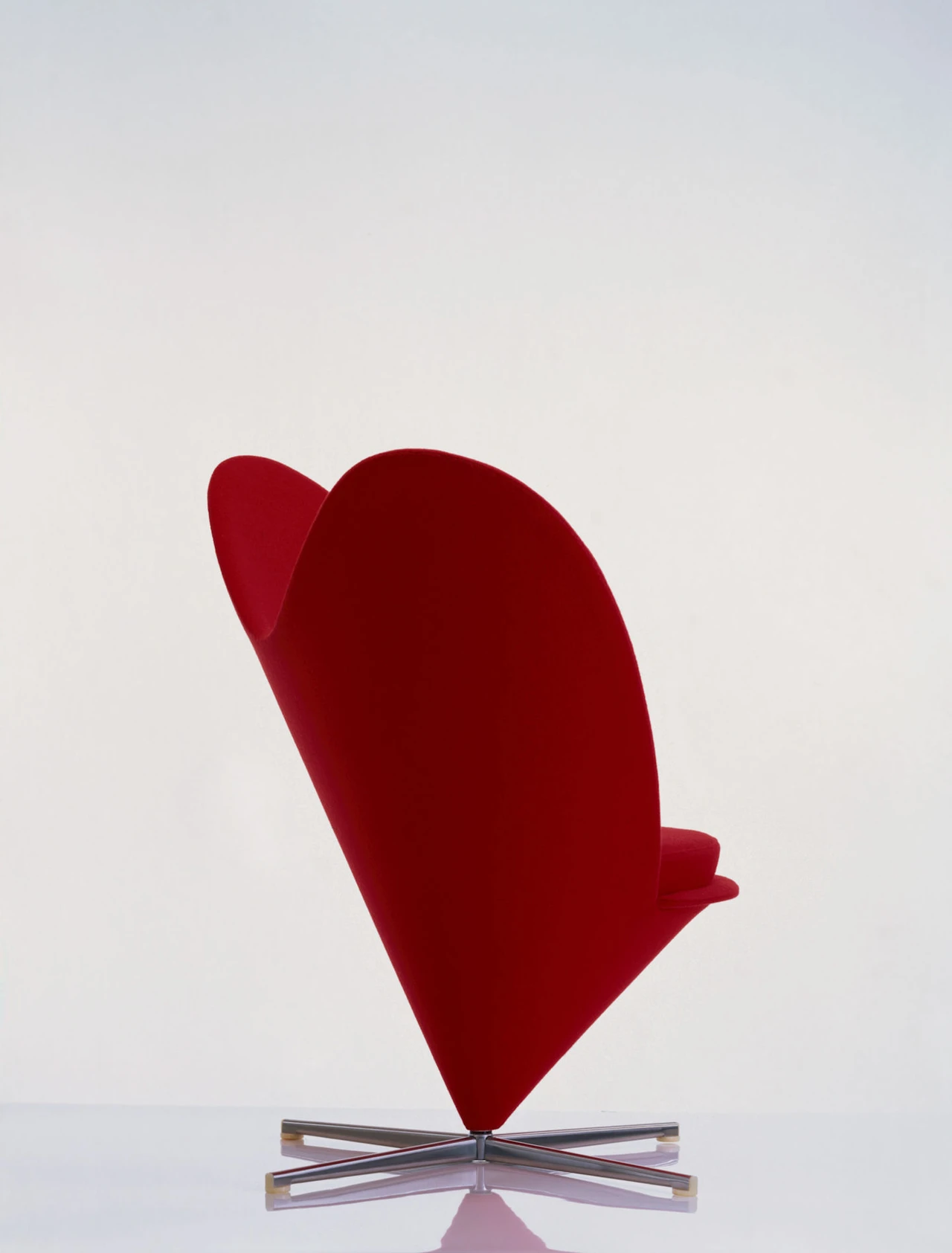
A museum reading shifts the chair away from sentimentality by describing the Heart Cone as a pop reinterpretation of the wing chair, the classic armchair with “ears.” That comparison does more than name a reference. It explains function.
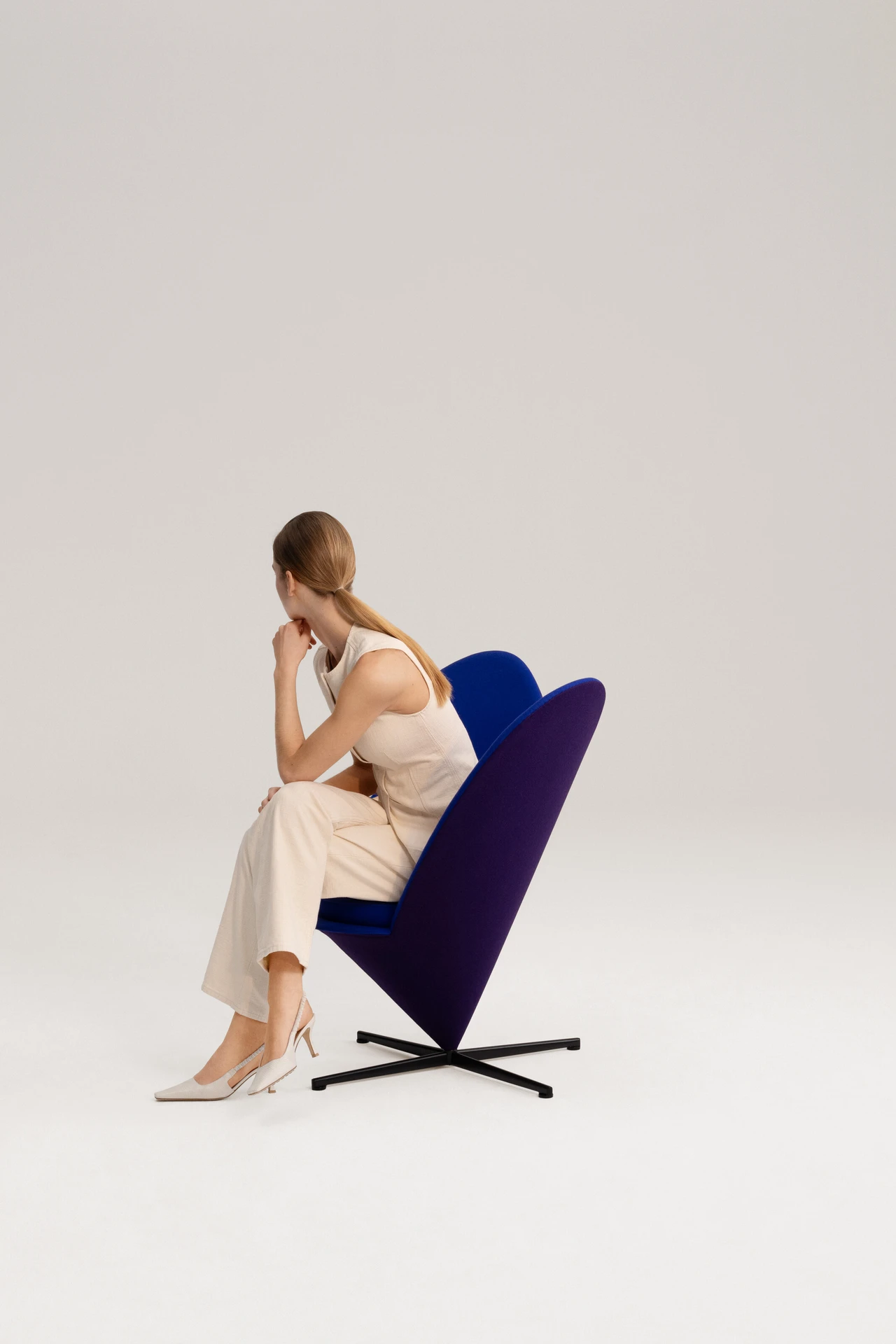
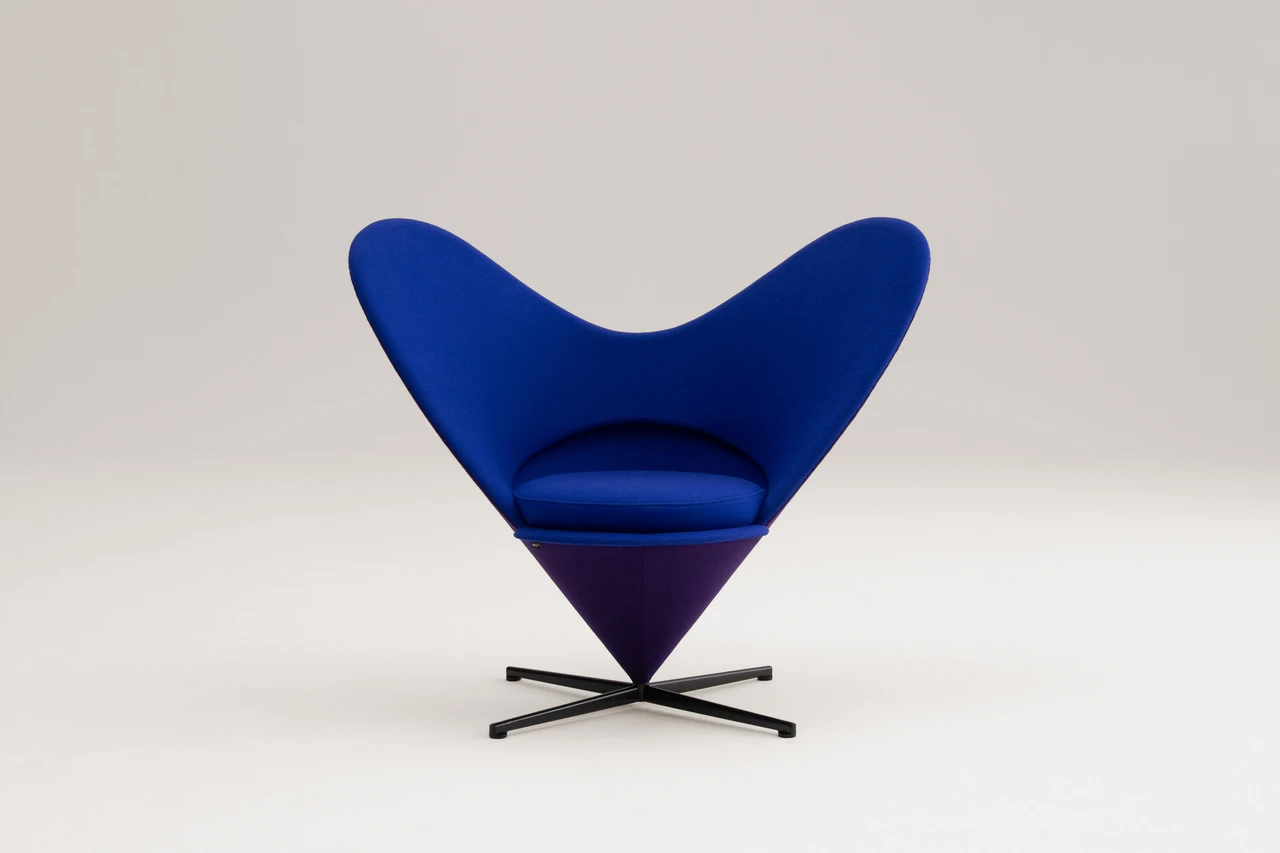
Those two lobes are not a symbol; they are lateral architecture. They offer comfort, yes, but they also define a small perimeter around the sitter. They give you privacy without enclosure, and they draw a clean outline around your shoulders. The chair does not hide the sitter; it frames them.
Then comes the detail that turns posture into behavior: the swivel base. Sitting becomes a micro-choreography: you rotate, you choose an angle, you respond to a glance, you retreat a few degrees, you return. Ergonomics, certainly. Also social scripting at a 1:1 scale.
Museum records emphasize the material intelligence behind this effect. The RISD Museum registers an example dated 1958-1959, made with a combination of metal and plastic components and upholstered in wool, and attributes its manufacture to Plus-linje.
DIRECTING CROWDS, ANCHORING ATTENTION
If you want a less expected angle on Panton, look at his obsession with collective dynamics. In 1959, commissioned to design the Köbestævnet exhibition, he proposed hanging part of the display from the ceiling so visitors could see it even when a crush of bodies blocked the view. The idea is not about a product.
Read the Heart Cone Chair through that lens, and a technical note becomes a revelation. The official archive indicates the base can be anchored to the floor. This is not a domestic flourish. It is a contractual clue, and it changes the chair’s aura. It suggests public settings where the order of a room matters as much as its image, and where the chair is allowed to be bold but not allowed to drift.
2026: THE CENTENARY AS A REREADING, NOT A SHRINE
The year 2026 marks the centenary of Panton’s birth, and the programs announced around it read less like a memorial and more like a live edit. Vitra and the Vitra Design Museum have planned a year of events and initiatives in collaboration with the Panton family-owned company, the Verner Panton Design AG. The highlights include exhibitions, product launches in new textiles and leathers, limited editions, and the reissue of one of his most playful designs.
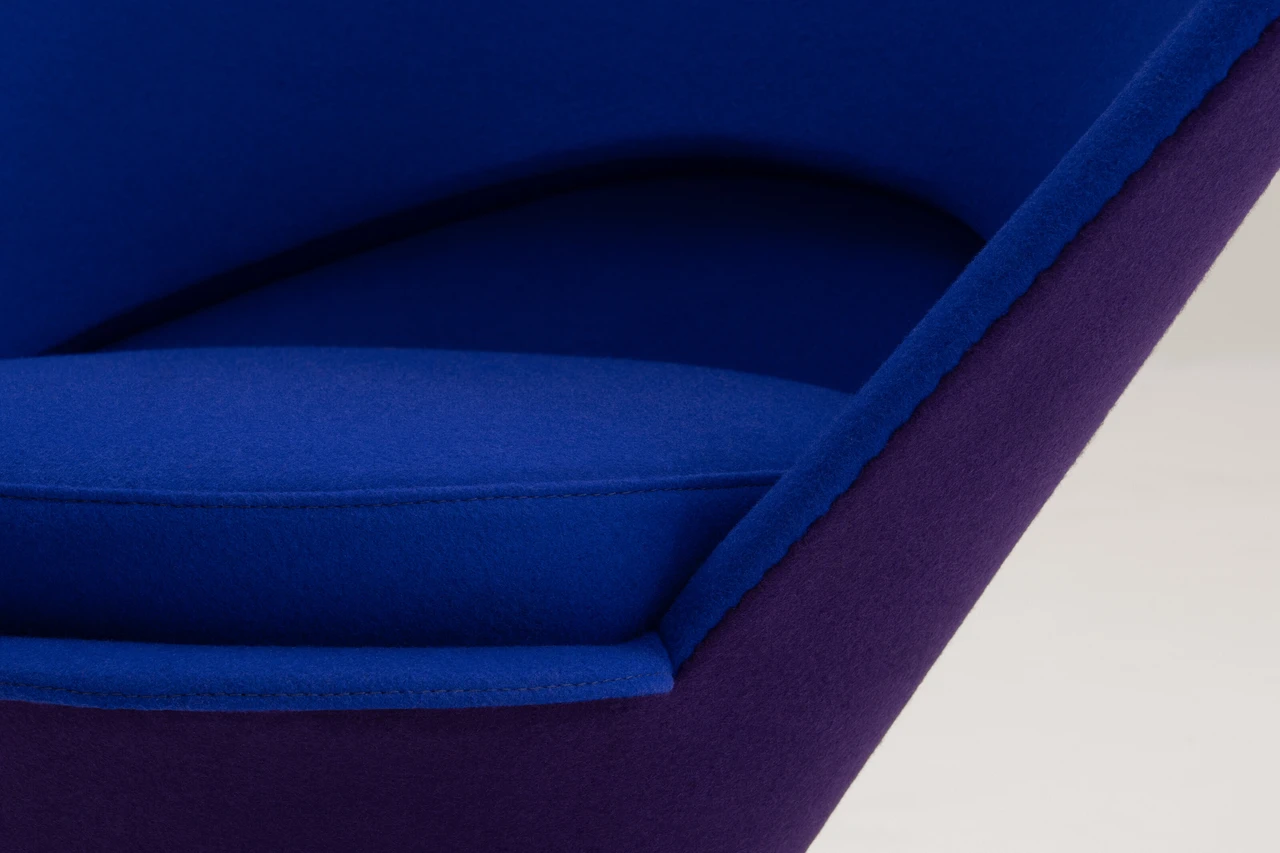
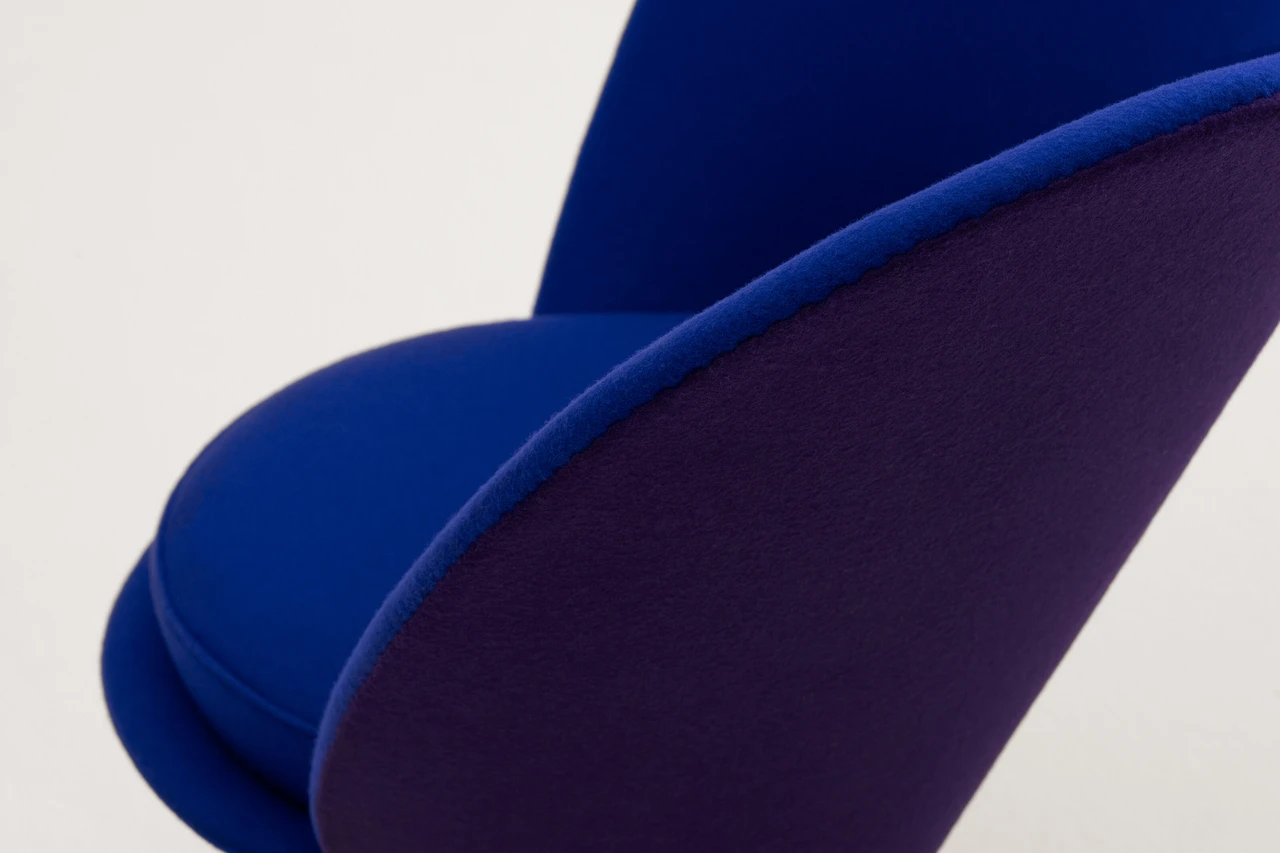
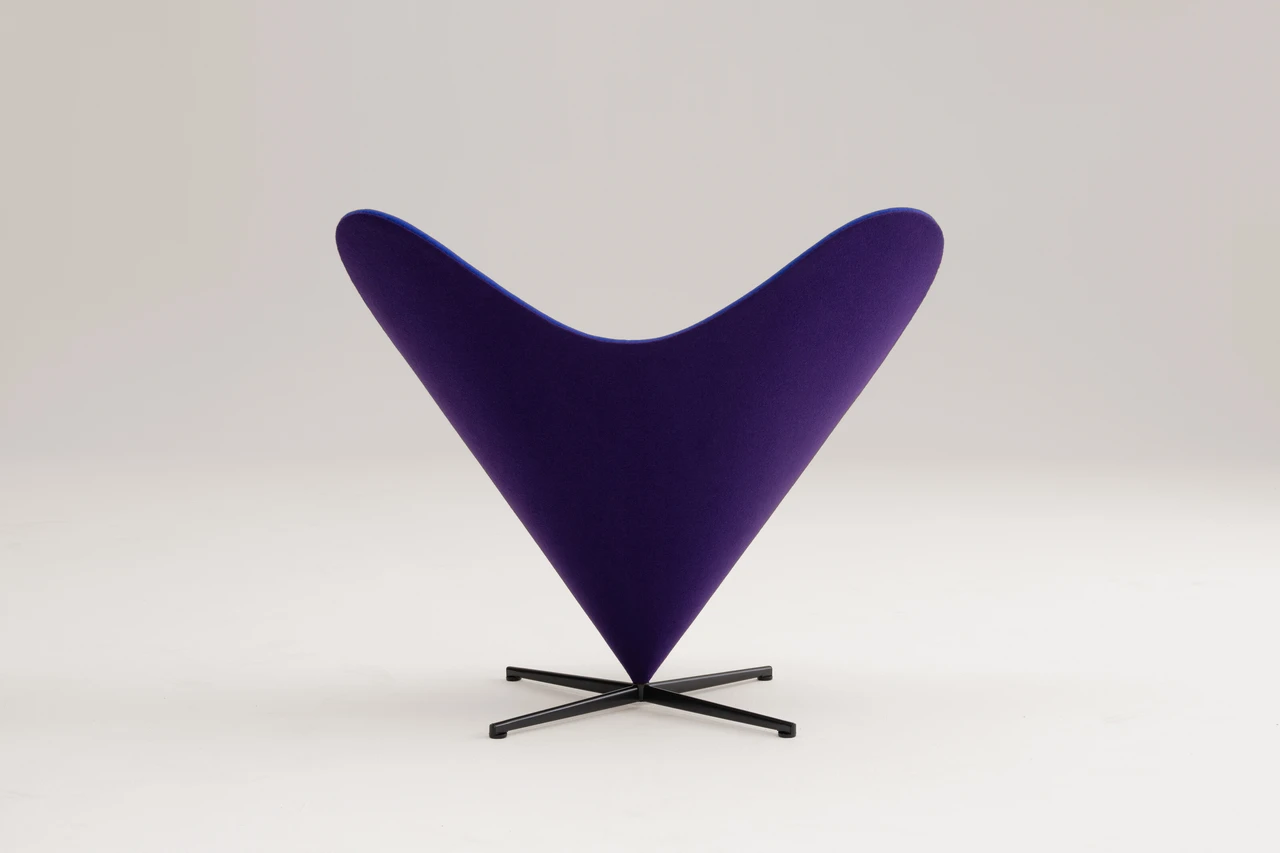
On the product side, Vitra and Verner Panton Design AG will release a limited Heart Cone Chair Anniversary Edition to mark what would have been Panton’s 100th birthday on February 13, 2026. The chair arrives in a bicolor version, front and back finished in two different shades of blue.
On the institutional side, the Vitra Schaudepot dedicates “Verner Panton: Form, Colour, Space” (May 23, 2026, to May 9, 2027) to two gestures stated upfront: letting chairs float from the ceiling and building organic landscapes you can inhabit. The Kunstgewerbemuseum in Berlin prepares “World of Colours: 100 Years of Verner Panton” (November 13, 2026, to May 23, 2027), explicitly inviting an experience “with all the senses.” Designmuseum Danmark also signals centenary initiatives in a more popular register, including a film projection, a documentary by in collaboration with DR.
BEYOND THE ANNIVERSARY, HOW THE COLLABORATION ENDURES
In Bogense, on the Danish island of Funen where Verner Panton grew up, his centennial will be celebrated with a series of events, among them an outdoor exhibition showing Panton’s journey from North Funen to the international design scene and telling the story of how great ideas can grow out of small places.
This network matters because it mirrors how Panton’s professional collaboration with Vitra evolved into a lasting bond with his family. In the early 1960s, after Panton moved to Switzerland, he and Vitra began developing the Panton Chair based on his first full-scale model from 1958.
The collaboration continues today in close cooperation with the Panton family and the rights holder, Verner Panton Design AG, through the preservation and ongoing development of selected works. The trace continues through Marianne Panton and their daughter Carin Panton von Halem, and through re-editions of products such as Cone Chair, Heart Cone Chair, Amoebe, Amoebe Highback, Visiona Stool, and Living Tower, which Vitra has produced since 2004.
The Vitra Design Museum conserves one of the most important collections of Verner Panton’s work, described as a key resource for exhibitions, loans, and publications, always with the approval of Verner Panton Design AG.